
The Real-World Dilemma of Photocatalysis
Photocatalytic technologies have long shown exceptional potential in controlled laboratory settings—especially under intense ultraviolet (UV) irradiation. In such ideal conditions, common photocatalysts like TiO₂ demonstrate high degradation rates for volatile organic compounds (VOCs) and formaldehyde, often achieving near-complete mineralization.
However, the promise rarely translates fully into real-world applications.
The core issue lies in a critical mismatch between testing environments and practical usage scenarios. While UV light constitutes over 90% of the illumination in lab experiments (e.g., under UV lamps), its share in natural sunlight is less than 5%, and is nearly absent in indoor settings due to architectural glass blocking. This fundamental oversight means that many conventional photocatalysts lose most of their activity when deployed in homes, offices, or inside vehicles—where air purification is most needed.
To bridge this performance gap, we must rethink photocatalyst design with real-world light conditions in mind.
Numerous studies have demonstrated that introducing noble metals—particularly platinum (Pt)—into photocatalytic systems can significantly enhance catalytic activity. Platinum plays multiple roles: it facilitates charge separation, accelerates surface redox reactions, and in some cases, contributes to mild thermocatalytic functionality. As a result, Pt-modified photocatalysts (e.g., Pt/TiO₂) have become a major focus in advanced materials research.
However, these improvements are largely observed under UV-dominant laboratory conditions. In practical environments, Pt-based systems still suffer from limited response to visible and near-infrared (NIR) wavelengths, which severely restricts their performance under daylight, indoor lighting, or shaded conditionsTo overcome this fundamental limitation, we developed a new generation of photocatalyst: PtAg-PC.
Engineered with a multi-metal composite architecture in which platinum is a core component, PtAg-PC maintains strong UV absorption while significantly expanding spectral responsiveness into the visible and near-infrared ranges.
UV-Vis-NIR diffuse reflectance testing shows a broad, continuous absorption profile, allowing PtAg-PC to harvest the majority of the solar spectrum—including the often-overlooked NIR band, which accounts for over 50% of solar energy.
More importantly, PtAg-PCexhibits a pronounced photothermal synergistic effect under real sunlight. Even in environments with little to no UV radiation—such as indoors, on cloudy days, or inside vehicles—the catalyst maintains high VOC degradation activity, effectively breaking the long-standing dependency of photocatalysts on artificial or direct UV light.
Spectral Analysis: UV-Vis-NIR Diffuse Reflectance
To evaluate the light-harvesting capabilities of PtAg-PC, we conducted UV-Vis-NIR diffuse reflectance spectroscopy (DRS) on three representative materials: bare TiO₂ (P25), Pt/TiO₂, and PtAg-PC.
The results reveal a clear trend in spectral responsiveness:
TiO₂ exhibits strong absorption in the UV region but loses most responsiveness beyond 400 nm. As a result, it becomes inactive under visible or NIR light.
Pt/TiO₂ introduces a slight red-shift in UV absorption and gains minor responsiveness in the visible region due to Pt-induced band modulation. However, its NIR activity remains minimal.
PtAg-PC, by contrast, demonstrates broadband absorption that spans UV, visible, and NIR regions. The visible and NIR absorption are significantly enhanced, producing a long absorption tail extending toward 1100 nm.
This extended spectral coverage is critical for real-world applications: while UV accounts for less than 5% of sunlight, visible and NIR together comprise over 90%. By leveraging these abundant wavelengths, PtAg-PC unlocks photocatalytic activity in light conditions where conventional materials fail.
The enhanced light absorption in the visible-NIR regions also lays the foundation for PtAg-PC's photothermal synergy, enabling efficient surface heating and VOC activation under diffuse or indirect light.
| Catalyst | UV Absorption | Visible Light Absorption | NIR Absorption |
|---|---|---|---|
| TiO₂ (P25) | Strong (λ < 400 nm) | Negligible | None |
| Pt/TiO₂ | UV edge red-shifted | Weak absorption (400–500 nm) | Barely detectable |
| PtAg-PC | Strong + red-shifted UV | Enhanced across visible (400–750 nm) | Continuous tail into NIR (750–1100 nm) |
Photothermal Synergy: Beyond Photocatalysis
In addition to its broad-spectrum light absorption, PtAg-PC exhibits a significant photothermal effect, a property derived from the engineered interplay between its multi-metal components and optimized nanoarchitecture.
When exposed to sunlight—particularly in the near-infrared (NIR) region—PtAg-PCdoes more than just generate electron-hole pairs. It also efficiently converts incident light into localized thermal energy, leading to measurable increases in catalyst surface temperature.
How This Enhances Catalytic Performance:
Thermal Activation of Pollutants
Mild heat at the catalyst interface lowers activation energy barriers for the breakdown of VOCs such as formaldehyde, enhancing reaction rates even in low-light conditions.Enhanced Adsorption
Elevated surface temperatures improve the adsorption kinetics of gaseous molecules, especially under ambient humidity, increasing the probability of effective surface reactions.Dark-State Activity
Notably, even in the absence of light (i.e., in dark or weakly lit environments), PtAg-PCretains measurable catalytic activity through thermally driven pathways.
Controlled experiments show near-100% formaldehyde removal at room temperature, with complete mineralization into CO₂ and H₂O, and no detectable toxic byproducts.
A Distinct Advantage in Real-World Settings:
Most photocatalysts become inert without direct UV illumination. PtAg-PC, however, harnesses both light-drivenand heat-assisted mechanisms, enabling it to function in:
Overcast or shaded outdoor environments
Indoor spaces illuminated by warm LEDs or indirect sunlight
Enclosed settings like vehicle cabins or office interiors
This dual-mode capability ensures continuous air purification performance across variable light conditions—making PtAg-PC far more resilient, adaptable, and effective than conventional materials.
This stacked bar chart shows the approximate distribution of solar radiation across three key spectral regions—UV (ultraviolet), visible light, and NIR (near-infrared)—during different times of a typical sunny day:
· Violet (UV): Less than 6% even at peak hours (10am–2pm), nearly negligible in the morning and evening
· Gold (Visible): Relatively stable, contributing ~35–40% of total energy
· Orange (NIR): The dominant portion of sunlight, ranging from ~54% to 64% depending on the time

Solar Light Composition at Different Times of Day
Implication for Photocatalysis
Since UV makes up only a small fraction of natural light, photocatalysts that rely solely on UV (like TiO₂ or Pt/TiO₂) become significantly limited under real-world conditions.
By contrast, PtAg-PC, with strong responsiveness to both visible and NIR light, is well-suited for consistent performance throughout the day—even under indirect or filtered sunlight.
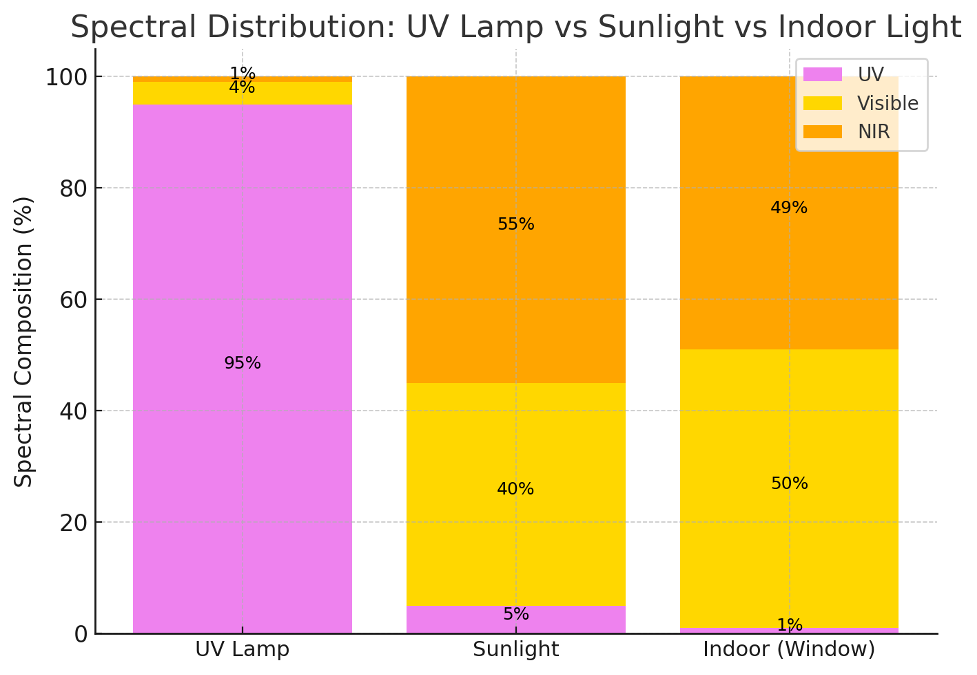
Spectral Distribution: UV Lamp vs Sunlight vs Indoor Light
• UV Lamps deliver a light spectrum heavily dominated by ultraviolet radiation (≈95%), making them suitable for laboratory testing but unrepresentative of actual usage scenarios.
• Sunlight contains a much broader distribution, with UV accounting for just 5%, and over 90% of the energy falling into the visible and near-infrared (NIR) regions.
• Indoor daylight—especially behind glass—contains almost no UV. Most modern windows filter out over 90% of UV radiation, leaving visible and NIR as the only functional light sources.
This discrepancy explains why traditional UV-dependent photocatalyst perform well in lab tests but poorly in real conditions.
PtAg-PC, by contrast, is engineered to harvest visible and NIR light efficiently, maintaining consistent photocatalytic activity in environments where conventional materials fail.
Catalyst Activity Under Real-World Conditions
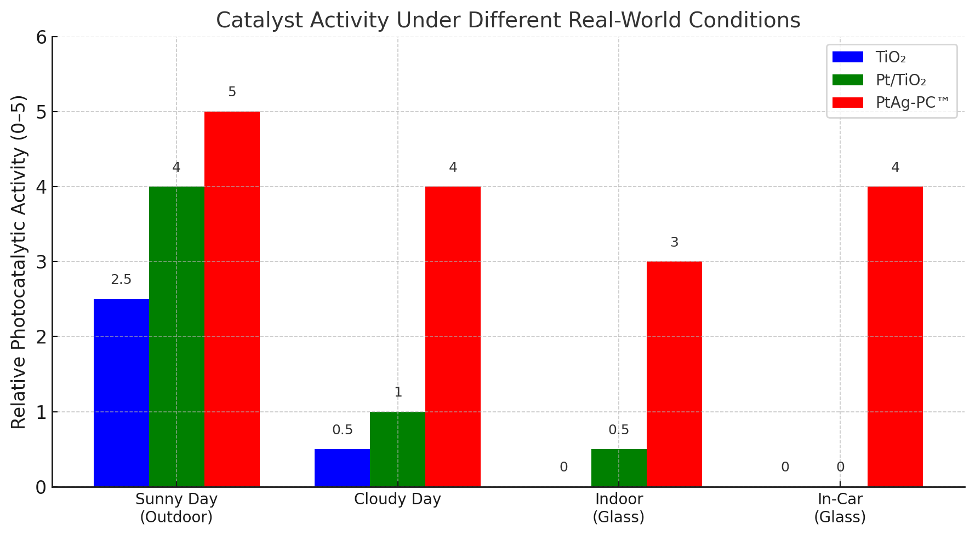
· TiO₂: Requires strong UV radiation; inactive in glass-filtered or low-light settings.
· Pt/TiO₂: Performs well under direct sunlight, but loses most activity in indoor or shaded environments.
· PtAg-PC: Maintains strong photocatalytic response across all conditions, including low-UV, indoor, and in-car environments, thanks to its visible and NIR light responsiveness.
This confirms that PtAg-PCis designed for real-world performance, overcoming the UV-dependence bottleneck of traditional photocatalysts.
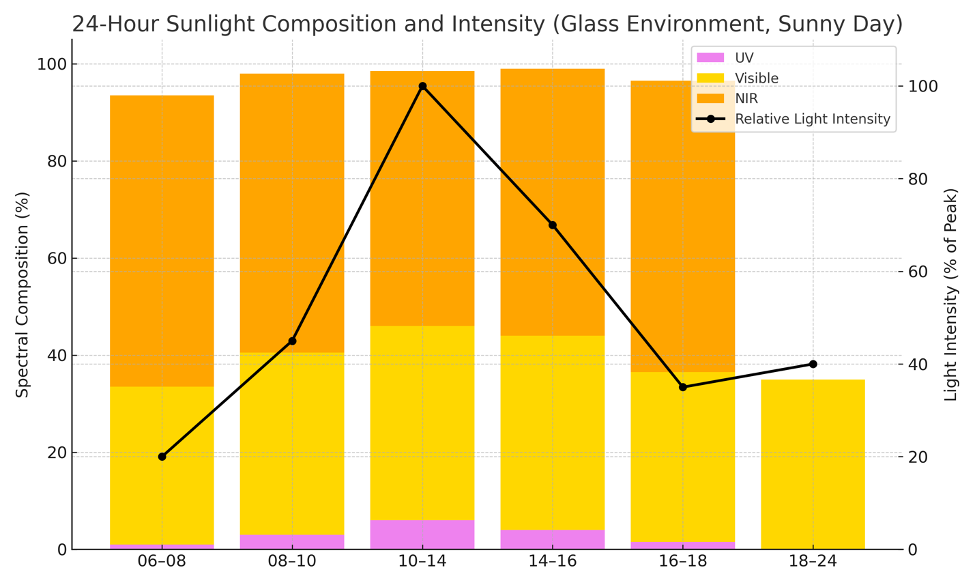
24-Hour Sunlight Composition and Intensity (Behind Glass, Sunny Day)
This chart illustrates the hourly variation of UV, visible, and NIR light percentages throughout the day, along with relative sunlight intensity.
Notably, UV remains consistently low, while visible and NIR light dominate—especially in the morning, afternoon, and indoor scenarios. This supports the need for photocatalysts like PtAg-PCthat respond efficiently to visible and NIR light.
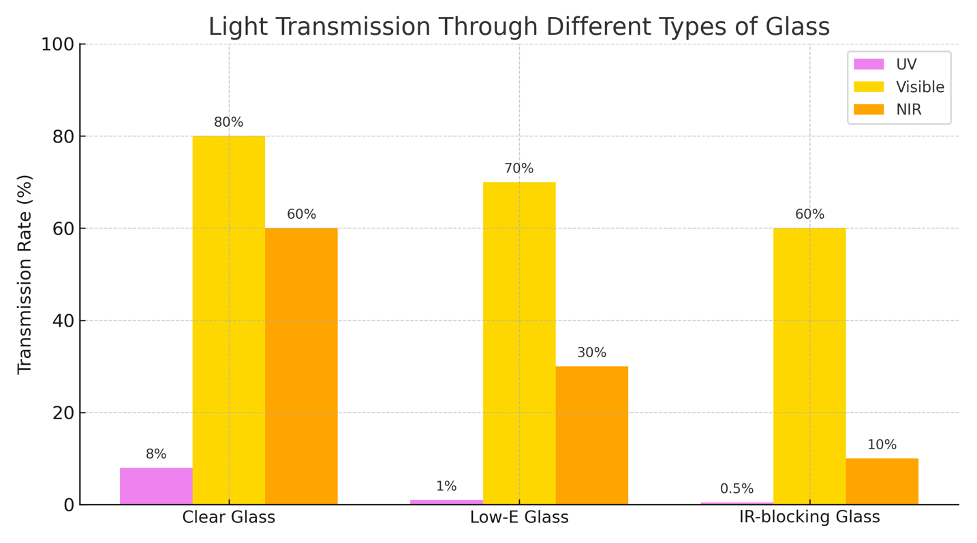
Light Transmission Through Different Types of Glass
This chart illustrates the light transmission rates of different types of architectural or automotive glass.
While normal glass blocks most UV, Low-E glass and insulated films block nearly all UV and much of NIR, while allowing partial visible light.
This explains why UV-driven photocatalysts are ineffective indoors or in vehicles, where UV transmission is near zero.
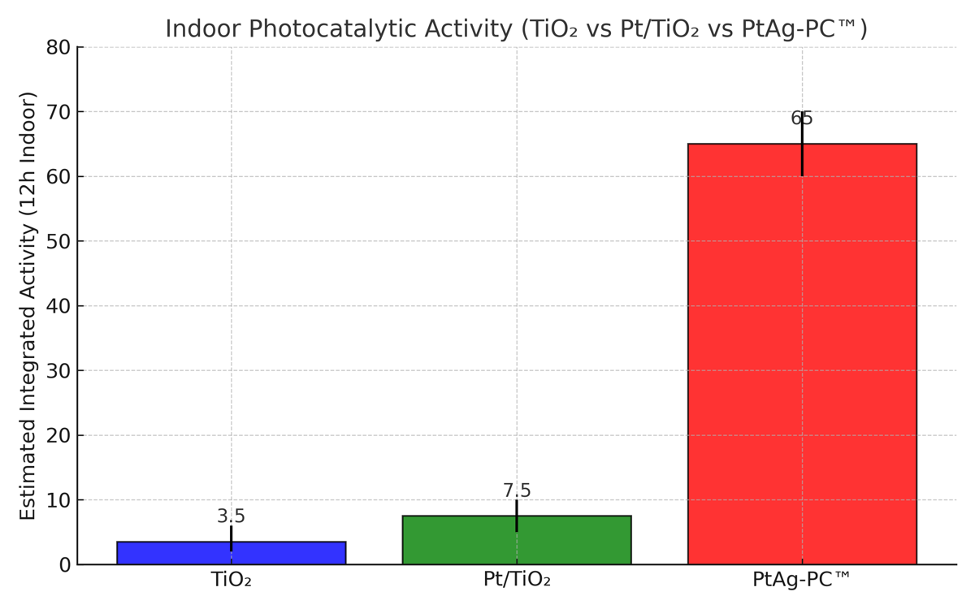
Estimated Indoor Photocatalytic Activity (12h)
Bar chart comparing the average integrated activity of TiO₂, Pt/TiO₂, and PtAg-PCunder indoor daylight exposure.
Error bars reflect performance variance due to material quality and ambient light fluctuations.
PtAg-PCshows significantly higher and more stable output compared to UV-dependent catalysts.
Photocatalyst Performance Summary
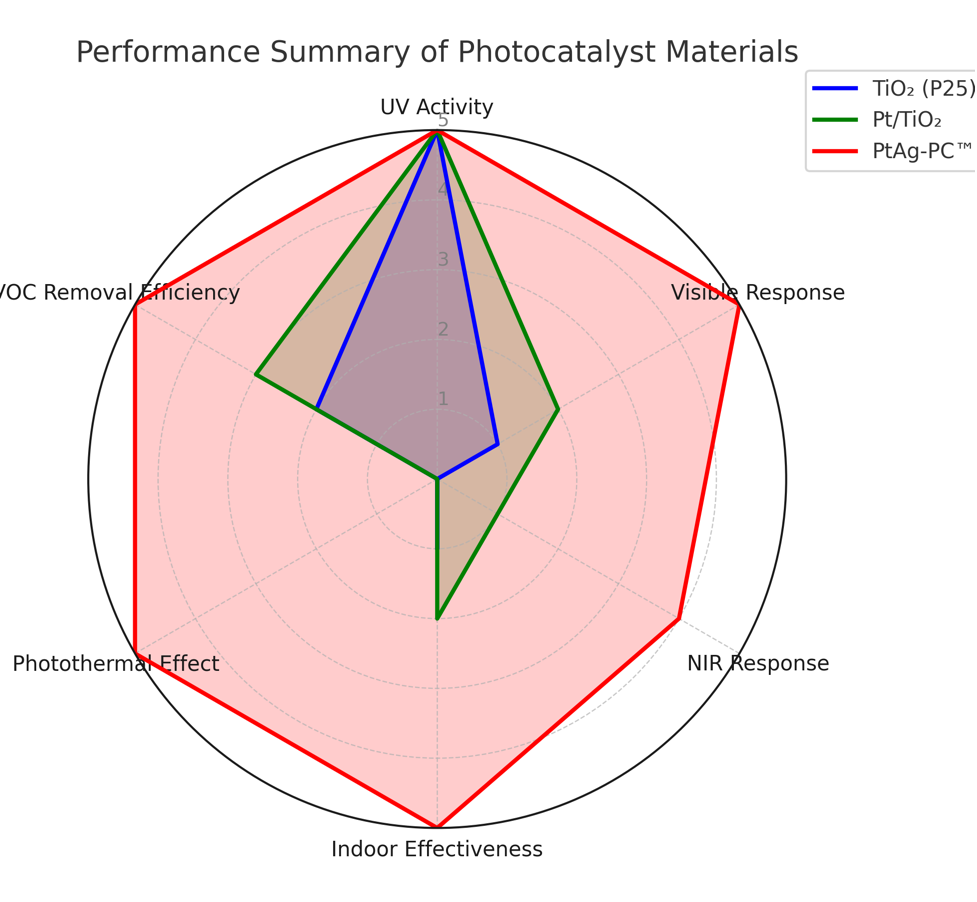
Radar chart comparing the functional capabilities of TiO₂, Pt/TiO₂, and PtAg-PC.
PtAg-PCexcels across all key categories—including visible/NIR responsiveness, photothermal effect, and real-world performance—making it ideal for modern indoor and low-UV environments.
Conclusion: Harnessing the Full Spectrum for Cleaner Air
As the limitations of conventional UV-dependent photocatalysts become increasingly evident in real-world environments, PtAg-PCstands out as a next-generation solution. With its broad-spectrum light response, enhanced indoor effectiveness, and robust photothermal synergy, it redefines what’s possible in air purification technology.
Whether in homes, vehicles, or industrial spaces, PtAg-PCensures sustained VOC and formaldehyde decomposition—even under low-light or indirect sunlight conditions.
Explore how PtAg-PCcan elevate your product or application—contact our team for technical support or collaboration opportunities.